Showing posts with label St. Johns Riverkeeper. Show all posts

Sunday, February 24, 2008

Florida's Water Problem

Being in Jacksonville, our view of the 'water problem' tends to focus on the St. Johns River mostly because it runs right through our city. As I was recently reminded by Neil Armingeon, the St. Johns Riverkeeper, the water problem is a state-wide concern and should be treated as such.

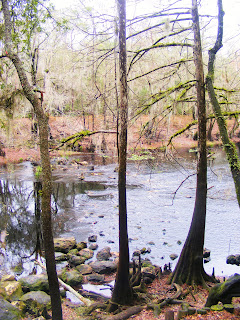
The point was driven home this weekend on my camping trip to O'Leno State Park, where the Santa Fe river sinks below the ground and later reappears at the aptly-named River Rise Scenic Preserve three miles away. As we walked along the river, we could clearly see it was significantly lower than it should be. We guessed, based on the vegetation near the riverbank and past trips, that it was a least 6 feet lower than last year.

As you can imagine, much of our conversation along the walk surrounded plans to withdraw over 150 million gallons of water per day from the St. Johns and guessed that someone, somewhere, was suggesting the same plans for the Santa Fe, despite it's visibly low water levels.
Guess what? Two minutes worth of research on the 'net and we found that, indeed, someone is trying to withdraw water from the Santa Fe.

"Our Santa Fe River, Inc." is a grassroots organization dedicated to educating their community on potential water withdrawls. From their website:

Our Santa Fe River, Inc. has been sharing information with you for nearly a year regarding 4 more water bottling facilities coming to the Santa Fe River within a 3-mile stretch of riverfront. They would withdraw a combined total (with the one already operating, CCDA or Coca-Cola/Danone), of 1.3 billion gallons annually. We have been sending you this information so when the time came, you would be ready to come to government meetings and voice your concerns or simply come as a warm body in protest of this outrageous business… the business of bottling your public natural resource, WATER, for huge corporate profits.

WE NEED YOUR HELP now to show your support for the health of the river, springs and aquifer. Voice your opinion on the future of water use. Let your public officials know how you feel about businesses depleting more water than any one of our towns use in one day. We urge you to mark your calendar, save the date, and be there to make your statement a part of our history.

Our Santa Fe River, Inc.
1-386-454-2366,
oursantafe@hotmail.com

It only takes one visit to the Santa Fe, or the St. Johns, or the Ichetucknee, or the Withlacoochee, or the Suwanee to understand that the health of these rivers are at stake. And once you marvel at their beauty, you will want to protect them.

I've posted a few photos I took of the Santa Fe this past weekend. I hope you are inspired to take a weekend to visit one of these amazing natural beauties and teach your friends and family that they must be protected.


And, for those that doubt I'm the 'roughing it' type of camper, I've included a proof-of-camping shot, too. (Note the LEED-EB Reference Guide. Just shows that I never fully leave work behind.) :-)

Friday, February 8, 2008

Are you a Keeper? We are...

A Riverkeeper, that is. If you are passionate about green building, then you're probably passionate about water conservation and quality. If you're passionate about water conservation and quality, then you probably look at the St. Johns River and worry about what will happen to that incredible natural resource in light of the 'water wars' occuring in both Florida and Georgia. If you worry about the St. Johns, then you probably should be part of Riverkeeper.

Jimmy Orth, Executive Director of St. Johns Riverkeeper, recently wrote a back page article for Folio Weekly and, as always, articulated the need for water conservation so much better than I can. With that, his words:


After reading my last Backpage article, a friend sent an e-mail to me bemoaning the fact that I had made her feel hopeless and helpless thanks to my pessimistic forecast for Florida’s environmental future. Despite my sincere regret for leaving her feeling this way, I realized just how important the point that I was trying to make really is. There are still reasons to be optimistic, but we can’t expect to just make small changes, if we are to create a sustainable future for Florida. How many times have you heard that “every little bit helps”? Do a Blackle (more energy-efficient Google page) search for this phrase, and you will see what I mean. Community leaders, politicians, and environmentalists (including me) have been baited into the trap of telling people what they want to hear and avoiding the harsh reality that doing only a little bit may only be buying us a little bit of time. In my opinion, this is one of the reasons that “going green” is now trendy. If I can be "green", cool, and clear my conscience by simply buying a hip organic t-shirt or taking a cloth bag to the grocery store, then I am all over it. Yes, the small things are important, but only if they are a part of sweeping lifestyle and cultural changes. The time for a paradigm shift is now. We have to reestablish our relationship with the natural world and fully integrate an environmental consciousness and ethic into every aspect of our lives and the decisions that we make. If we don’t, the bulk of the decisions we make will continue to be contrary to our own best long-term interests and those of the planet.

Even though this may sound daunting and leave readers feeling overwhelmed, there is still hope and good reason to pull our selves up by the boot straps and get to work. Now, is the time and the opportunity to rev up that ol’ American can-do attitude, celebrate our entrepreneurial spirit, and embrace our American ingenuity and eagerness to take on and overcome challenges. This is our chance to forge a new future for our state that will result in a healthier environment, more stable economy and a better quality of life. This is the time to reconnect with Mother Nature and the environment upon which we depend for our own survival and quality of life. This is our opportunity to celebrate and preserve the natural history, beauty, and richness of the great state of Florida.

First of all, as I mentioned before, we must reconnect with the natural world. We must understand and accept our role in this complex global system and start listening for and recognizing the heartbeat of our planet, once again. We can do this by learning, exploring and getting to know our surroundings – the flora, fauna, waters, lands, and of course, our fellow human beings. Develop and cultivate your sense of place. Rekindle and nurture the relationship with the natural world around you. What we don’t know we won’t love, we won’t respect, and we won’t feel a sense of responsibility to care for. We have to understand the interdependence of all living things and the importance of maintaining the ecological balance of the world in which we live. The best way to do this is by experiencing and learning about it firsthand. Get in that canoe or kayak. Get on that bicycle. Go for a hike. Sign up for an educational Riverkeeper boat trip.

Secondly, simply be conscious. The outdoor clothing company, Patagonia, calls it leading an examined life. So often, we just don’t think about the consequences of our actions. What is the impact of the fertilizers that run off of my lawn? Where did my food come from and how was it produced? By simply being more conscious, observant, and aware, you will inevitably make more responsible decisions. To get you started, I would suggest that you visit the American Public Media website (
http://sustainability.publicradio.org ) and play the Consumer Consequences game. It’s pretty cool and will at least get you thinking about whether or not you are living a sustainable lifestyle. Once you are more aware, you will then recognize the chain of events and ripples that emanate from our actions and will be more prepared to minimize your ecological footprint.

Next, we have to be open to new and old ideas. We must be willing to embrace those concepts and technologies that will enable us to plan our communities, build our homes and office buildings, restructure our organizations, and live our lives in a much more sustainable manner. For instance, New Urbanism planning principles, Low Impact Development techniques, and LEED certified buildings provide opportunities for us to dramatically reduce the impact of our built environment. The technologies and know-how are there that will allow us to create more efficient, more resourceful, and more earth-compatible communities. The only thing missing is the will to do so.

Get involved. Use your voice and your vote. We all need to become more engaged in our communities. Attend public meetings where decisions are made that have an impact on environmental policy and regulations. Elect candidates who support the environment. Communicate frequently with your elected officials and let them know what is important to you. Help start a community garden in your neighborhood or recycling program at your office.

Make more informed decisions. Information is one of the most critical components to an effective democracy and free market system. There are a number of great resources available online that can help you make greener choices. Consumer Reports has a site about “products for a better planet,”
www.Greenerchoices.org. Co-op America (www.coopamerica.org ) has a Green Business Directory and information about social investing and green energy. St. Johns Riverkeeper (www.stjohnsriverkeeper.org) provides tips for protecting the river, information about Low Impact Development techniques, and “river friendly” yard practices. The local nonprofit, Green Team Project (www.greenteamproject.org), helps individuals and businesses “save money by becoming environmentally-friendly in their everyday practices.” The League of Conservation Voters (www.lcv.org) is an independent nonprofit organization that provides environmental scorecards for national and state legislators. After all, if we want to go green, we will have to vote green.

Finally, we must be willing to walk the walk. Follow-through is essential. It may be difficult at times to find environmentally-friendly products, services, or even political candidates, but we must attempt to, and we must demand that those choices are available. Start out by reaching for the low-hanging fruit (such as installing a low-flow showerhead or compact fluorescent light bulb or using a cloth shopping bag). Then, work on further greening up your everyday life by identifying ways to minimize your ecological footprint and establishing a plan for achieving your goals. What is it going to take to make your home more energy efficient? Could you better plan your shopping for the week so that it requires fewer trips by car? Can you fix that old appliance or could you get a used one on craigslist.com? Plan ahead, think through your options and the environmental impacts of each, and make wise decisions. Hey, you might just find that you’ll also save some money, and you will be helping to create a more sustainable Florida in the process.

If you have come to the conclusion that this is just some idealistic tree-hugger rant, consider that much of what I am proposing may actually be just old-fashioned conservative American values. This is about conserving resources, being frugal and not wasteful, prudently preparing and planning for the future, having a deep-rooted connection to the land, using only what you need, and respecting and being good stewards of God’s creation. This is about recognizing that we have gotten off track and need to get back to the basics, back to our roots. This is baseball and apple pie. The New York Times columnist, Thomas Friedman, refers to it as “green patriotism” and proclaims green to be “the new red, white, and blue.” However, he also recognizes that while “green has hit Main Street….it’s still less than a new way of life.” As Friedman says, “Green has to become part of America’s DNA.” Well, what are we waiting for? Yes, we may have our work cut out for us. However, our sustainable future is within our grasp if everyone will just get started by doing a little bit, with the willingness and commitment to do a whole lot more.

-Jimmy Orth, Executive Director St. John's Riverkeeper

Thanks to Folio Weekly for providing Jimmy the opportunity to share this vital message.

Lastly, we at Breaking Ground are proud to be Keepers and hope to expand our own water conservation initiatives to complement what the Riverkeeper is doing. Keep an eye out for news of our most recent incentive for our employees to conserve water... I may be hitting you up for suggestions and out-of-the-box ideas on how I can take advantage of this incentive AND make a huge dent in our potable water use.

Until then, visit the Riverkeeper's webpage and blog, and consider including them in your annual contributions.

They need you and the river needs you!

Thursday, October 25, 2007

Tallahassee, we have a problem...


We have a water problem. No, it's not just Atlanta. No, it's not just South Florida. Jacksonville have a water problem, too. St. Johns Riverkeeper says it so much better than I do, so I'll use their words. Here's the overview:

  • According to the St. Johns River Water Management District (SJRWMD), Central Florida has out-stripped the Floridan Aquifer's ability to provide a sustainable drinking water source beyond 2013. The District has told communities they will have to seek alternative water supply (AWS) sources, such as surface water and desalinization.
  • The SJRWMD has stated that 155 million gallons of water per day (MGD) can be removed from the St. Johns River between the headwaters and Deland to provide water for Orlando and Central Florida without harming the health of the river.
  • Because river water has a high salt or mineral content, most withdrawls will require treatment by reverse osmosis, or RO. A by-product of RO is high mineral content and/or very salty water. RO water is also high in nutrients. The by-products, or pollutants, are called "concentrate". The SJRWMD recently began a study to determine the impacts of the concentrate on the river environment. The study will end in a year.
  • The SJRWMD is also focusing its attention on the lower Ocklawaha River. Although District staff has not set a minimum flow level, of MFL, for the Ocklawaha River, the agency is telling counties to expect to be able to withdraw 90-108 MGD from the Ocklawaha.
  • The withdrawls from the St. Johns and Ocklawaha could total 263 million gallons per day.
  • Withdrawls from the St. Johns will impact the river's salinity line.
  • One of the largest proposed water withdrawls, Yankee Lake, is planned in an area just south of the Wekiva Aquatic Preserve. Also, this plant could eventually discharge RO concentrate into the river.
  • The only county proposing to withdraw water from the River that has a mandatory water conservation plan is Volusia County. None of the other counties or municipalities that are planning water withdrawls has mandatory water conservation programs.
  • The proposed withdrawls will cost of $1 Billion. These plans will only provide drinking water needs until around 2030, less than 25 years into the future.
St. Johns Riverkeeper Concerns:

  • Riverkeeper is concerned that the withdrawls from the St. Johns and Ocklawaha could potentially cause significant harm to the health of both rivers.
  • The withdrawls will cause the St. Johns River's salinity line to shift upstream, especially during drought and low flow conditions. No one, including the SJRWMD, fully understands all of the potential impacts of the river's health and fisheries from the proposed withdrawls.
  • In addition to withdrawing water from the St. Johns and Ocklawaha, the SJRWMD is also proposing to utilize Aquifer Storage Recovery, or ASR. ASR is a process that injects minimally treated water back into ground water aquifers for storage until it is needed at a later date. There are significant risks associated with this procedure.
  • "Concentrate" from RO processes could hard the St. Johns River's health by adding additional pollutants to an already stressed system. Riverkeeper is concerned the SJRWMD could issue numerous withdrawl permits before the RO concentrate study is completed.
  • The SJRWMD has not required mandatory conservation programs in an attempt to reduce the need to withdraw river water, despite the fact that residents within the watershed of the St. Johns use approximately 150 gallons of water per person each and every day.
  • All of the District's studies rationalizing and/or minimizing the environmental impacts of water withdrawls have been done 'in house', i.e. written by staff or consultants paid for by the District. There has been no independent review of any of these reports.
  • Once the river water withdrawl process begins, it will be extremely difficult to reverse course, even if the act results in harm to the river's ecological health.
  • Riverkeeper is concerned that this may only be the beginning of water withdrawls from the St. Johns and its tributaries. As groundwater supplies continue to be depleted, there will be more pressure to continue this process and allow additional withdrawls in the future.
  • The SJRWMD has poorly managed our groundwater supplies and how wants to manage the withdrawl of water from our rivers. The District should turn its attention to water conservation, desalinization, and more sustainable planning practices before ever considering the St. Johns and Ocklawaha as an alternative supply sources.
  • The St. Johns River is one of the "laziest" rivers in the world, dropping less than 30 feet from its source at its mouth. This fact combined with tidal influences makes it difficult for our river to efficiently flush pollutants and sediments. Removing the amount of water that is being proposed will potentially worsen pollution problems.
What can you do:

Let Governor Crist, the SJRWMD Governing Board, and your local elected officials know that you oppose the proposal to withdraw water from the St. Johns River and Ocklawaha River. Tell them to require and support water conservation and desalinization efforts first.
Visit St. Johns Riverkeeper's webpage to find email addresses and form letter to send to your elected officials.

Take a moment this weekend to visit YOUR river. Go to the Landing... go to Cummer... Go to the Riverwalk... Take a Water Taxi ride. Experience the River and you will want to protect it.

Thursday, September 13, 2007

You tell 'em, Riverkeeper!

Be sure to take a look at this week's Folio Weekly for Jimmy Orth's backpage editorial. If you aren't familiar, Jimmy is the executive director of St. John's Riverkeeper. Here are a few excerpts that I think are particularly brilliant:

"We need to put our politics aside and make a serious, dedicated commitment to sustainability. We need to honestly acknowledge all environmental impacts,not just the most convenient or politically palatable. Then, we must commit ourselves to those solutions necessary to allow us to realistically accommodate existing populations, as well as future growth, without further depleting or degrading our natural resources. We can't let politics, money, greed or short-sightedness get in the way. We can't allow the complexity or difficulty of the task deter us or cause us to compromise our goals."

"The time has come for us to accept the fact that being 'green' is not merely cool or politically popular, it is an absolute necessity. I am not referring to buying a hybrid automobile, building an Energy Star home or recycling, calling it good and feeling as if you've done your part. I'm talking about adopting a holistic approach to the environment that means completely integrating green principles and practices into our lives, governments and markets."


Jimmy's article is filled with examples of good intentions with less-than-inspiring follow through. Examples of organizations that say one thing and do another. Examples of when we could have done the right thing, but lazily did the wrong.


Examples of when we've tried, but simply not done enough.

Orth is encouraging those of us that support sustainability to push it further. Don't settle for what we're doing today. Do more. And then do a little more. Not because it's going to make you feel good, but because it is absolutely REQUIRED to keep Florida alive.

"Environmental consciousness and awareness is more than just the latest trend or
fad. It is the foundation upon which we should build our state and live
our lives." -Jimmy Orth, St. Johns Riverkeeper


Couldn't have said it better m'self. Spread the word, kids....

Wednesday, August 15, 2007

Avoid the Green Monster

Ewww.

I was browsing the St. John's Riverkeeper website which led to browsing the web for photos of past algae blooms. My daughter summed it up nicely: "It looks kinda cool... in that horror-movie creepy sorta way."


Welcome to Jacksonville. Let me introduce you to our "horror-movie creepy" river.


*sigh*
"Algae blooms are caused by too many nutrients. One source of nutrients is
the fertilizers that enter our river through storm drains and from runoff.
Algae blooms, pesticides and herbicides can harm us and our river."
-- St.
Johns Riverkeeper
So, what can we do? Today? Right now? Here's a list (taken directly from the wonderful resources at St. John's Riverkeeper):


  • Slow it down: Use only slow-release, low-phosphorous fertilizers, or have your lawn service do so. Use organic fertilizers, if possible. Avoid fertilizers that contain chemical weed killers. Remember, less is best. Use no more than necessary. And always try to avoid applying fertilizers before a heavy rain.

  • Twice is nice: Make your grass stronger by watering no more than twice a week, and only if necessary. Water early in the morning and adjust sprinklers to only water your grass, not streets and driveways.

  • Put it to bed: Create beds with low-maintenance plants next to streets, driveways and waterways to help prevent runoff and reduce lawn size. Consider using native plants. Use an organic mulch (not cypress) around plants to retain moisture and slow runoff.

  • The drain is for the rain: Never sweep clippings or debris down the storm drain. Drains eventually lead to the river. Mow high and keep your blade sharp. Never cut off more than one third of the grass blade. This will result in a healthier lawn and cut down on the amount of fertilizers and water you need to use.

Once you've done those (and instilled those practices as habit with you and your family), consider becoming a member of St. John's Riverkeeper. They need your $$ to continue their work.